

Consultation and Public Exhibitions
In January 2023, we held a public exhibition in the local area to enable people to find out more about the proposal and provide us with their views. RES staff were available to answer any questions or queries, and comment forms were available to gather feedback.
The feedback was taken into account along with the results of site surveys and assessments, as we refined the design.
All information provided at the public exhibition is available to view below.
Why Solar?
-
- Renewable energy at lowest cost to the consumer1
- Tackling climate change by supporting the UK’s target of net zero by 2050
- Specifically designed to be dual purpose, combining continued agricultural use and renewable generation
- Quick to deploy
- Modern, efficient technology allowing more electricity generation in less space
- Diversification of agricultural business
- Significant biodiversity enhancement opportunities, supporting new & existing plant & animal habitats
- High level of public support2
Design layout and infrastructure
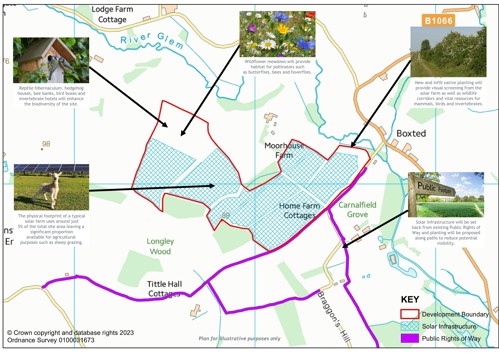
The plan to the right shows the preliminary layout for Boxted Solar Farm which will be capable of producing 20MW of clean and renewable electricity. The preliminary layout is based on initial findings from environmental and technical surveys which are ongoing. We are currently consulting on this layout and as such, it is subject to change. In addition to the solar panels, the site infrastructure is expected to include:
- A network of on-site access tracks
- A substation/transformer with security fencing
- Inverters on hardstandings
- Temporary construction compound
- Deer fencing around the perimeter of the solar farm
Click on image to enlarge
Environmental considerations
RES design their solar farms so that they will fit sensitively in the surrounding landscape.
As part of the planning process, RES carries out a number of detailed technical and environmental surveys to ensure any potential impact upon the environment, landscape, heritage and local residents is appropriately assessed and mitigated. These assessments include:
- Landscape and Visual Effects
- Archaeology and Cultural Heritage
- Ecology and Biodiversity Net Gain
- Agricultural Land Classification
- Transport and Access
- Flood risk and Drainage
- Glint and Glare
- Arboriculture
- Noise
- Cumulative Effects
The results of these surveys, along with feedback from the local community and stakeholders, are taken into account as the design of the solar farm is refined and finalised. The assessments will accompany any planning application that is made.
Landscape and Ecology
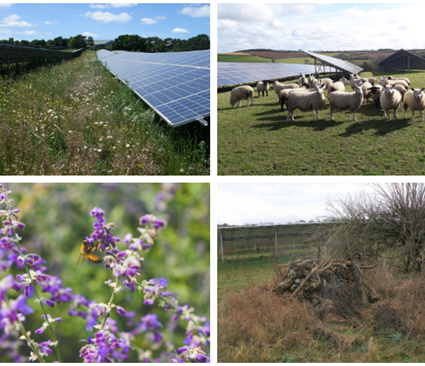
The plan below shows a preliminary Landscape and Ecological Management Plan (LEMP).
The Preliminary LEMP illustrates our immediate and long-term commitment to deliver landscape planting as well as the protection and enhancement of biodiversity around the site.
As the design progresses, the LEMP will be developed further with site-specific details on measures to enhance existing habitats, protect species and provide landscaping specifications for new vegetation in accordance with relevant standards. In addition, the LEMP will provide information on the timings and aftercare regime for all planting for the lifetime of the proposed Boxted Solar Farm, if it is consented.
Click on image to enlarge
Transport and Access
Access is an important consideration when selecting a potential solar farm site.
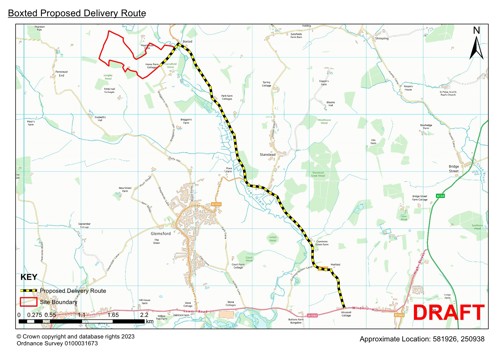
A transport survey is ongoing in consultation with the Highways Authority. The preliminary plan below shows the potential access route currently under consideration which could be used for delivery of materials and access for construction and maintenance.
We will consult with Suffolk Highways, Babergh District Council, local parish councils, the emergency services, the local community and other relevant bodies to produce a Construction Traffic Management Plan (CTMP) to support any future planning application. The CTMP outlines the overall framework for managing the safe movement of construction and delivery traffic as well as itemising the expected number of traffic movements and timing restrictions.
The traffic movements will be limited to avoid morning and evening peak times, where possible. There will also be a dedicated Community Liaison Officer to engage with local residents throughout the construction and operational phases, if the solar farm is consented.
Click on image to enlarge
How Solar Works
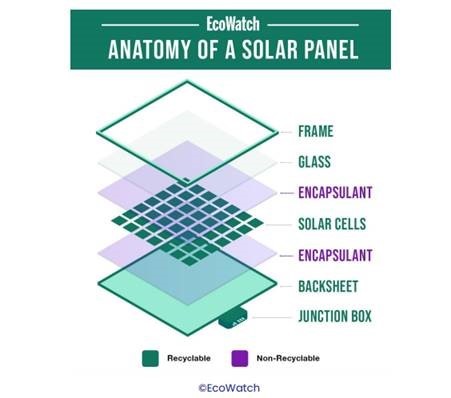
Solar PV panels are typically made from silicon, which is a great semi-conductor, installed in a fixed metal panel frame with a glass casing.
The sun gives off light, even on cloudy days, and when these light particles, or photons, hit the thin layer of silicon on the top of a solar panel, they knock electrons off the silicon atoms which creates a direct current (D C) of electricity. This is captured by the wiring in the solar panels.
This DC electricity is then converted to alternating current (AC) by an inverter which is then funnelled into the grid network. AC is the type of electrical current used when you plug appliances into normal wall sockets.
Bifacial modules have two sides of solar cells, enabling additional energy generation from the diffuse light reflected off the grass, on the rear-side of the panels.
In most cases solar panels are recyclable and there are well established industrial processes to do this. There are organisations around the UK and Europe specialising in solar recycling, such as PV Cycle and the European Recycling Platform.
They are working with solar developers to minimise electrical waste and recycle old panels in line with the Waste from Electrical and Electronic Equipment (WEEE) regulations.
Please note that comments submitted to RES at this time were not representations to the determining authority (Babergh District Council). There was an opportunity to submit representations to the determining authority when the application was made.
1 https://assets.publishing.service.gov.uk/media/6556027d046ed400148b99fe/electricity-generation-costs-2023.pdf
2 https://solarenergyuk.org/wp-content/uploads/2022/01/Copper-Consultancy_Solar-Energy-UK_Public-attitudes-to-solar_January-2022.pdf